
Physical Activity And Health-Related Quality Of Life Of Patients On Hemodialysis With Comorbidities: A Cross-Sectional Study
Jul 14, 2023
Patients on hemodialysis with multiple comorbidities have limited physical activity, resulting in poor health, low activity participation, and low quality of life. Accordingly, the nursing care provided to such patients should include regular physical activity training programs. Therefore, this cross-sectional descriptive study investigated whether patients on hemodialysis with and without comorbidities have different levels of physical activity and health-related quality of life (HRQoL); the correlations among the comorbidities, physical activity, and HRQoL of the two cohorts were also assessed. The 36-Item Short-Form Health Survey version 2 and International Physical Activity Questionnaire were employed to collect data from 120 patients on hemodialysis. An independent samples t-test and univariate and multivariate linear regression analyses were conducted. The overall HRQoL of patients with comorbidities was lower than that of patients without comorbidities (p=0.008). Compared with patients who participated in low-intensity physical activity, the overall HRQoL of patients who participated in moderate-intensity physical activity was higher (p < 0.001). The overall HRQoL of patients with comorbidities who participated in low-intensity physical activity was lower than that of those who participated in moderate-intensity physical activity (p < 0.001). Moderate-intensity physical activity was correlated with higher HRQoL for patients with comorbidities. This finding supports the implementation of effective physical activity intervention measures. Furthermore, it supports the promotion of patient self-management and the implementation of regular exercise programs and lifestyle changes, and patients on hemodialysis can benefit from the future management of physical activities.
hemodialysis; comorbidity; physical activity; health-related quality of life (HRQoL)

The most common comorbidities of patients on hemodialysis are hypertension, diabetes, and cardiovascular diseases. These comorbidities can cause complications and can result in limited physical activity and low quality of life [1–3]. In addition, the risk of patients on hemodialysis with declining physical function and reduced muscle and bone mass is higher than that of normal people. Studies have suggested that patients should exercise at least five days a week and engage in moderate-intensity activities that last for 30 min or longer [4]. Their energy expenditure must reach at least 600 metabolic equivalents of tasks (METs). An energy expenditure of less than 600 METs among these patients indicates that their physical activity level is insufficient, and they should intensify their physical training to prevent further decline in their physical function [5,6].
In Taiwan, chronic kidney disease (CKD) is the ninth most common cause of death [7], and the incidence of hemodialysis increased from 10,668 people in 2014 to 12,346 in 2018. The prevalence of hemodialysis in Taiwan is 3587 per million people, and the number of patients on hemodialysis is increasing by 3 percent to 4 percent annually. Approximately 94,000 patients undergo hemodialysis every year. This figure is the highest globally, and hemodialysis is becoming a major public health problem in Taiwan [8]. Approximately 40 percent of patients on hemodialysis have two or more comorbidities [8]. The development of diseases and clinical abnormalities in these patients causes negative effects, such as the rapid reduction of muscle tension and strength, reduced physical activity, poor prognoses, and low health-related quality of life (HRQoL) [9,10].
Patients with CKD must undergo two to three sessions of hemodialysis every week, with each session lasting between 3 and 4 h. Therefore, compared with healthy people, their physical activity level is 35 percent lower, and their physical tolerance is also lower [11–13]. Approximately 47.4 percent of all patients have limited time for physical activity and become accustomed to a sedentary lifestyle. With time, patients on hemodialysis tend to develop symptoms, such as fatigue, muscle soreness, and cramping as well as reduced lower extremity muscle strength. The severity of these symptoms is negatively correlated with their physical activity levels and HRQoL. Relative to patients without multiple comorbidities, those with multiple comorbidities have poorer physical health and limited physical activity, resulting in lower physical activity participation [11,12,14–16] and a higher mortality rate [17]. Furthermore, the presence of multiple comorbidities aggravates their diseases, contributes to their medical burden, and increases their mortality risk [10]. Few studies have evaluated how the presence of comorbidities in patients on hemodialysis affects their level of physical activity and HRQoL. Therefore, the present study compared the physical activity levels of patients on hemodialysis with comorbidities and those without comorbidities and determined how their level of physical activity affects their HRQoL.

1. Design
This study is a descriptive cross-sectional study.
2. Participants
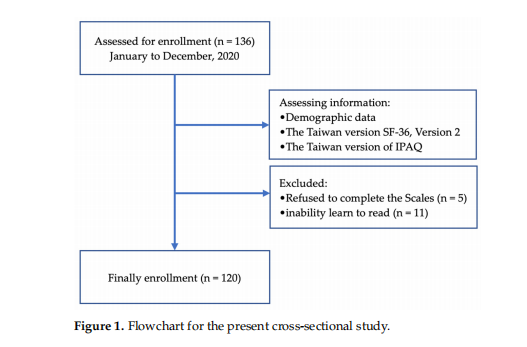
Patients on hemodialysis were recruited from the outpatient clinic of a medical center in Northern Taiwan between January and December 2020. In total, 120 patients completed the 36-Item Short-Form Health Survey version 2 (SF-36) and the abbreviated version of the International Physical Activity Questionnaire (IPAQ) used in Taiwan (Figure 1). The Charlson comorbidity index (CCI) comprises 19 diseases that are weighted based on their association with mortality [18]. The present study used the CCI to measure the comorbidity severity of patients on hemodialysis. As selected by physicians, the study population included patients who regularly received hemodialysis for Greater than or equal to 3 months at a frequency of three times a week, with each session lasting Greater than or equal to 3 h; were Greater than or equal to 20 years old; were conscious; we're able to communicate clearly in Chinese or Taiwanese; were literate; and were willing to participate in the present study after the purpose of the study was explained to them. We excluded patients with cognitive disabilities or mental illnesses (because such patients cannot properly respond to our questionnaire), patients who could not care for themselves, and patients who were hospitalized at the time of recruitment.
The required sample number was estimated using the G*Power version 3.1.9 [19] software. A linear multiple regression model F-test was conducted, with the effect size (f2 ), significance level, and power being {{0}}.2, 0.05, and 0.80, respectively. With a projected attrition rate of 10 percent , the required sample size was estimated to be Greater than or equal to 104.
3. Measurement
The demographic data of the participants included age, gender, education, marital status, living arrangement, current employment, monthly income, body mass index (BMlkg/m?), comorbidities, regular physical activity (three times/week), and duration of hemodialysis (years). The biochemical data of the participants included dialysis efficiencyKt/V), normalized protein catabolic rate (nPCR), hemoglobin level (mg/dL), blood urea nitrogen level (BUN; mg/dL), creatinine level (mg/dL), albumin level (g/dL) (20].
HROoL was assessed using the Medical Outcomes Study {{0}}Item Short-Form HealthSurvey version 2 (SF-36). The questionnaire contains 36 items under eight subscales as follows: physical functioning (10 items), role-physical (4 items), bodily pain (2 items), general health (5 items), vitality (4 items), social functioning (2 items), role-emotional(3 items), mental health (5 items), and health transition (1 item). The eight subscales belong to the two constructs of physical component score (PCS) and mental component score(MCS) (21]. The total score ranges from 0 to 100, with a higher score indicating better health and higher quality of life (22]. The Cronbach alpha of the questionnaire has been reported to be greater than 0.70 (22].
The present study used Taiwan's abbreviated version of the International Physical Activity Questionnaire (IPAQ) for measuring physical activity (23]. The scale was used to examine how much time the participants spent on physical activities over the past7 days, the types of physical activities they engaged in that lasted more than 10 min, and the duration of such activities. Physical activity intensity was measured using the physical activity metabolic equivalent of task (MET; kcal/h/kg). MET is the product of the resting metabolic rate multiplied by time (6]. The activities were categorized as low-intensity(<600 MET-min/week), moderate-intensity (600-2999 MET-min /week), and vigorous-intensity (>3000 MET-min/week) activities, and their overall physical activity score was calculated. The IPAO has excellent stability; Spearman's rho was used to test the IPAQ, and the results indicated that the IPAO had a reliability of 0.8 and criterion validity of 0.30 (24. Therefore, the IPAO is precise and effective.
The present study enrolled participants after obtaining approval from the relevant institutional review board (IRB number: 1-108-05-195). The participants provided oral and written consent, and they had the right to exercise their autonomy and refuse participation in or withdraw from the study at any time; the medical rights of the participants were not affected by their participation in the present study. All of the data collected in the present study were coded and used only for research purposes.
Statistical analysis was performed using SPSS version 22.0 (SPSS, Chicago, IL, USA), with the significance level set at 0.05. The participants' sociodemographics, quality of life, and physical activity data are presented as means, standard deviations (SDs), and percentages ( percent ). The associations among comorbidities, quality of life, and physical activity were evaluated using t-tests and generalized linear modeling (GLM). Multivariate analyses based on linear regression models were conducted, with adjustments for sociodemographic characteristics (age, gender, education, marital status, employment, monthly income, regular physical activity, duration of hemodialysis, and comorbidities) and physical activity.

Our results revealed that the overall quality of life of patients on hemodialysis with comorbidities was poorer than that of patients on hemodialysis without comorbidities. In addition, the patients on hemodialysis with comorbidities who exercised regularly had higher quality of life than those who did not exercise regularly. That is engagement in phys. ical activity improved the physical functioning and spirit of these patients. This confirmed that in patients on hemodialysis, regular exercise is a feasible and effective activity that can improve HRQoL and muscle strength and help delay their disease progression (25,26]For these patients, the implementation of moderate-intensity exercise training programs(e.g., aerobic exercises) can effectively improve the physical role, general health, and pain management domains of their HRQoL; increase their social interactions and enhance their self-attitude (27l: alleviate their disease-related conditions and complications; and improve their physical functioning and prognosis (28,29]. A study indicated that the level of physical activity of patients on hemodialysis is correlated to their HRQoL; the study also reported that relative to healthy people, habitual exercise is a stronger predictor of HROoL for patients on hemodialysis (301. Therefore, exercise and physical activity are crucial for treating and preventing multiple diseases. In other words, exercise is medicine (31]. Patients on hemodialysis usually have multiple comorbidities. Compared with patients with a single disease, the HROoL and physical functioning of patients with multiple comorbidities are more likely to be affected by various factors (32]. Studies have demonstrated that comorbidities aggravated the primary disease of patients and affected their general health and MCS (33]. The presence of multiple comorbidities is correlated with reduced PCS, MCS, and overall HROoL 2]. Multiple studies have confirmed that comorbidities and diseases affect each other and, consequently, the physical functioning and survival of patients. Comorbidities aggravate the severity of diseases; for patients quality of life decreases as the number of comorbidities increases, and the physical health of these patients is affected to a greater degree than their mental health (34). Compared with patients on hemodialysis without comorbidities, the overall HROoL of patients on hemodialysis with comorbidities is lower, and they are also more likely to experience declining health (34]. Therefore, medical personnel should focus on improving the HROolof patients on hemodialysis with comorbidities.
Physical activity is beneficial for CKD (35]. Regular physical activity can improve the physical functioning, muscle tension, strength, PCS, and MCS of patients (25,36n patients on hemodialysis, performing regular moderate-intensity exercises three times per week, with each exercise session lasting for more than 30 min, can improve their PC, MCS (37l, and HROoL in terms of the pain, physical role, and general health domains (24,38. Exercise can also improve the physical functioning of patients on hemodialysis. sis, stabilize their cognitive function, reduce their risk of developing health conditions, and improve their quality of life 39. Regular exercise improves the physical functioning andHROoL of patients (40). Patients on hemodialysis. age in physical activity exhibit high-quality life (3]. The quality-of-life score and daily physical activity are positively correlated (41). Hornik et al. [13) reported that compared with patients on hemodialysis who did not exercise regularly and engaged in less physical activity, patients who exercised regularly according to physical activity pans showed a lower incidence rate of complications; in addition, regular exercise improved their hemodialysis, physical functioning, role limitations of physical problems, social function, and PCS. The results of the present study revealed that the patients who engaged in moderate-intensity physical activity every week had higher HROoL than the patients who did not engage in moderate-intensity physical activity every week. That is, patients on hemodialysis with low physical activity had low-quality life. Therefore, engaging in regular physical activity and increasing the level of physical activity can improve the HROoL of patients on hemodialysis. A recent study in Tawan reported a correlation between comorbidities and the loss ofHROoL in analyses with adjustment for sociodemographic factors and medical comorbidities; this discovery is consistent with the results of the present study (42. Complications and the physical activity level affect HROOL. Possibly because an increase in the number of comorbidities results in deteriorating health, limited physical activity, and reduced activity participation among patients on hemodialysis 341, thereby affecting their HROoL. When patients engaged in more physical activity, the muscle strength and physical functioning removal ability of their kidneys and efficiency improved; this also improved their hemodialysis. Consequently, their HROoL improved (28,41]. Patients on hemodialysis with comorbidities can exercise regularly to improve their muscle strength and cardiovascular function, prevent cardiovascular diseases, and increase their survival rate, and benefits can also be gained from social interactions. In addition, regular exercise can improve the quality of life and physical functioning and can reduce the negative effects of complications 36,42). Our results revealed the HROoL of the patients on hemodialysis who engaged in moderate-intensity physical activity was lower than those without comorbidities. Therefore, we can actively encourage patients on hemodialysis with comorbidities to follow regular moderate-intensity physical activity training programs to improve their HROoLreduce the negative effects caused by their comorbidities and enhance their overall health also observed that regular physical activity and increased levels of physical activity are correlated with HROoL. Moreover, the educational level, marital status, and occupation. income, comorbidity, and regular hemodialysis of patients are associated with their HROoL.However, similar to other studies, sufficient evidence was not provided in the present study to support the correlation of age and gender with HROoL (43).

Studies have indicated that patients who have a lower educational level or no education, patients who are not married or widowed, unemployed patients, patients who have a low monthly income, and patients who have multiple comorbidities usually have poorer mental health, which directly affects their HROoL and is negatively correlated with their quality of life In addition, the quality of life of patients is negatively affected by a hemodialysis history of e2 years, lack of regular exercise, and lack of moderate-intensity exercise (29,43,44]. Therefore, regular physical activity is positively correlated with I'm. improvements in quality of life, PCS, and MCS. Physical activity is a predictor of quality of life (45). Daily moderate-intensity physical activity is correlated with improved SF-36scores (physical functioning, freedom from pain, vitality, and mental health) (46), and it reduces complications and improves physical functioning, HROoL, and prognoses (27,28The present study has several limitations. First, the study participants were patients from a single hemodialysis center in Northern Taiwan. Therefore, our results may have limited generalizability. Second, the cross-sectional design precluded the determination of long-term changes in physical activity and HRCL. Finally, the IPAQ used in the present study is a review scale and does not consider objective data. The other data in the scale were self-reported by the patients, who could have underestimated or overestimated their conditions; hence, the reliability and authenticity of the results are lower. Our findings indicate that the HROoL of patients on hemodialysis, particularly those with comorbidities, can be improved by providing early intervention involving regular moderate-intensity physical activity. Healthcare professionals should implement effective physical activity interventions to improve the physical activity level of these patients and encourage them to perform regular physical activity and adopt a more active lifestyle: these changes will improve their quality of life.

The present study revealed that among the patients on hemodialysis who engaged in low-intensity physical activity, those with comorbidities had lower HROoL relative to those without comorbidities. Furthermore, among the patients on hemodialysis with comorbidities, those who engaged in moderate-intensity physical activity had high school than those who engaged in low-intensity physical activity; this was because the latter group had a sedentary lifestyle that resulted in disabilities, and comorbidities aggravate the decrease in muscle tension, strength, and physical activities, all of which led to a poor prognosis. In our cohort, the quality of life of patients with comorbidities who exercised regularly was higher than that of patients with comorbidities who did not exercise regularly. Our findings support the promotion of moderate-intensity physical activity training programs, which can improve quality of life. These programs should play an essential role in the treatment plans and health promotion measures for patients on long-term hemodialysis with comorbidities.
1. Liu, J.; Huang, Z.; Gilbertson, D.T.; Foley, R.N.; Collins, A.J. An improved comorbidity index for outcome analyses among dialysis patients. Kidney Int. 2010, 77, 141–151. [CrossRef]
2. Cha, J.; Han, D. Health-Related Quality of Life Based on Comorbidities Among Patients with End-Stage Renal Disease. Osong Public Health Res. Perspect. 2020, 11, 194–200. [CrossRef]
3. Stojanovic, M.; Stefanovic, V. Assessment of health-related quality of life in patients treated with hemodialysis in Serbia: Influence of comorbidity, age, and income. Artif. Organs 2007, 31, 53–60. [CrossRef] [PubMed]
4. Roshanravan, B.; Gamboa, J.; Wilund, K. Exercise and CKD: Skeletal Muscle Dysfunction and Practical Application of Exercise to Prevent and Treat Physical Impairments in CKD. Am. J. Kidney Dis. 2017, 69, 837–852. [CrossRef] [PubMed]
5. World Health Organization. WHO Guidelines on Physical Activity and Sedentary Behaviour; World Health Organization: Geneva, Switzerland, 2020.
6. Bjordal, K.; de Graeff, A.; Fayers, P.M. A 12-country field study of the EORTC QLQ-C30 (version 3.0) and the head and neck cancer specific module (EORTC QLQ-H&N35) in head and neck patients. EORTC Quality of Life Group. Eur. J. Cancer 2000, 36, 1796–1807. [PubMed]
7. Health Promotion Administration, Ministry of Health and Welfare, Taiwan. 2019 Health Promotion Administration Annual Report. Available online: https://www.hpa.gov.tw/EngPages/Detail.aspx?nodeid=1070&pid=12811 (accessed on 19 October 2021).
8. Kidney Disease in Taiwan Annual Report. 2020. Available online: https://www.google.com.tw/url?sa=t&rct=j&q=&esrc=s& source=web&cd=&ved=2ahUKEwjejszbztbzAhDAIgKHXrOB5AQFnoECAkQAQ&url=https percent 3A percent 2F percent 2Fwww.tsn.org.tw percent 2FUI percent 2FL percent 2FL002.aspx&usg=AOvVaw09xbZt9TkeB2l3rgZIPLGx (accessed on 9 January 2022).
9. Visser, W.J.; Egmond, A.M.E.M.; Timman, R.; Severs, D.; Hoorn, E.J. Risk Factors for Muscle Loss in Hemodialysis Patients with High Comorbidity. Nutrients 2020, 12, 2494. [CrossRef] [PubMed]
10. Tonelli, M.; Wiebe, N.; Guthrie, B. Comorbidity as a driver of adverse outcomes in people with chronic kidney disease. Kidney Int. 2015, 88, 859–866. [CrossRef] [PubMed]
11. Gomes, E.P.; Reboredo, M.M.; Carvalho, E.V. Physical Activity in Hemodialysis Patients Measured by Triaxial Accelerometer. BioMed Res. Int. 2015, 2015, 645645. [CrossRef]
12. Johansen, K.L.; Chertow, G.M.; Ng, A.V. Physical activity levels in patients on hemodialysis and healthy sedentary controls. Kidney Int. 2000, 57, 2564–2570. [CrossRef] [PubMed]
13. Hornik, B.; Duława, J. Frailty, Quality of Life, Anxiety, and Other Factors Affecting Adherence to Physical Activity Recommendations by Hemodialysis Patients. Int. J. Environ. Res. Public Health 2019, 16, 1827. [CrossRef]
14. Cupisti, A.; D'Alessandro, C.; Bottai, A.; Fumagalli, G.; Capitanini, A. Physical activity and exercise training: A relevant aspect of the dialysis patient's care. Intern. Emerg. Med. 2013, 8 (Suppl. 1), S31–S34. [CrossRef]
15. Sheshadri, A.; Kittiskulnam, P.; Johansen, K.L. Higher Physical Activity Is Associated With Less Fatigue and Insomnia among Patients on Hemodialysis. Kidney Int. Rep. 2018, 4, 285–292. [CrossRef]
16. Diaz, K.M.; Howard, V.J.; Hutto, B. Patterns of Sedentary Behavior and Mortality in U.S. Middle-Aged and Older Adults: A National Cohort Study. Ann. Intern. Med. 2017, 167, 465–475. [CrossRef] [PubMed]
17. Ware, J.E., Jr.; Sherbourne, C.D. The MOS 36-item short-form health survey (SF-36). I. Conceptual framework and item selection. Med. Care 1992, 30, 473–483. [CrossRef]
18. Charlson, M.E.; Pompei, P.; Ales, K.L.; MacKenzie, C.R. A new method of classifying prognostic comorbidity in longitudinal studies: Development and validation. J. Chronic Dis. 1987, 40, 373–383. [CrossRef]
19. Faul, F.; Erdfelder, E.; Lang, A.G.; Buchner, A. G*Power 3: A flexible statistical power analysis program for the social, behavioral, and biomedical sciences. Behav. Res. Methods 2007, 39, 175–191. [CrossRef]
20. Kim, J.C.; Young Do, J.; Kang, S.H. Comparisons of physical activity and understanding of the importance of exercise according to dialysis modality in maintenance dialysis patients. Sci. Rep. 2021, 11, 1–9. [CrossRef]
21. Lu, J.F.; Tseng, H.T.; Tsai, Y.J. Assessment of health-related quality of life in Taiwan (I): Development and psychometric testing of SF-36 Taiwan version. Taiwan J. Public Health 2003, 22, 501–511.
22. Liou, Y.M.; Jwo, C.J.; Yao, K.G.; Chiang, L.C.; Huang, L.H. Selection of appropriate Chinese terms to represent intensity and types of physical activity terms for use in the Taiwan version of IPAQ. J. Nurs. Res. 2008, 16, 252–263. [CrossRef] [PubMed]
23. Hallal, P.C.; Victora, C.G. Reliability and validity of the International Physical Activity Questionnaire (IPAQ). Med. Sci. Sports Exerc. 2004, 36, 556. [CrossRef]
24. Ibrahim, A.A.; Althomali, O.W.; Atyia, M.R. A systematic review of trials investigating the efficacy of exercise training for functional capacity and quality of life in chronic kidney disease patients. Int. Urol. Nephrol. 2021, 10, 1–10. [CrossRef]
25. Pu, J.; Jiang, Z.; Wu, W. Efficacy and safety of intradialytic exercise in hemodialysis patients: A systematic review and meta-analysis. BMJ Open 2019, 9, e020633. [CrossRef] [PubMed]
26. Pei, G.; Tang, Y.; Tan, L.; Tan, J.; Ge, L.; Qin, W. Aerobic exercise in adults with chronic kidney disease (CKD): A meta-analysis. Int. Urol. Nephrol. 2019, 51, 1787–1795. [CrossRef]
27. Marthoenis, M.; Syukri, M.; Abdullah, A. Quality of life, depression, and anxiety of patients undergoing hemodialysis: Significant role of acceptance of the illness. Int. J. Psychiatry Med. 2021, 56, 40–50. [CrossRef] [PubMed]
28. de Lima, M.C.; Cicotoste, C.D.L.; Cardoso, K.D.S.; Forgiarini, L.A., Jr.; Monteiro, M.B.; Dias, A.S. Effect of exercise performed during hemodialysis: Strength versus aerobic. Ren. Fail. 2013, 35, 697–704. [CrossRef]
29. Filipˇciˇc, T.; Bogataj, Š.; Pajek, J.; Pajek, M. Physical Activity and Quality of Life in Hemodialysis Patients and Healthy Controls: A Cross-Sectional Study. Int. J. Environ. Res. Public Health 2021, 18, 1978. [CrossRef]
30. Wilkinson, T.J.; Shur, N.F.; Smith, A.C. "Exercise as medicine" in chronic kidney disease. Scand. J. Med. Sci. Sports 2016, 26, 985–988. [CrossRef] [PubMed]
31. Fraser, S.D.; Barker, J.; Roderick, P.J. Health-related quality of life, functional impairment and comorbidity in people with mild-to-moderate chronic kidney disease: A cross-sectional study. BMJ Open 2020, 10, e040286. [CrossRef]
32. Markle-Reid, M.; Ploeg, J.; Fraser, K.D. Community Program Improves Quality of Life and Self-Management in Older Adults with Diabetes Mellitus and Comorbidity. J. Am. Geriatr. Soc. 2018, 66, 263–273. [CrossRef]
33. Makovski, T.T.; Schmitz, S.; Zeegers, M.P.; Stranges, S.; van den Akker, M. Multimorbidity and quality of life: Systematic literature review and meta-analysis. Ageing Res. Rev. 2019, 53, 100903. [CrossRef] [PubMed]
34. Moisoglou, I.; Margariti, E.; Kollia, K.; Droulias, J.; Savva, L. The role of demographic characteristics and comorbidities in hemodialysis patients' health-related quality of life. Hippokratia 2017, 21, 163–168. [PubMed]
35. Wang, I.K.; Tsai, M.K.; Liang, C.C. The role of physical activity in chronic kidney disease in the presence of diabetes mellitus: A prospective cohort study. Am. J. Nephrol. 2013, 38, 509–516. [CrossRef]
36. Afsar, B.; Siriopol, D.; Aslan, G. The impact of exercise on physical function, cardiovascular outcomes and quality of life in chronic kidney disease patients: A systematic review. Int. Urol. Nephrol. 2018, 50, 885–904. [CrossRef]
37. Takhreem, M. The effectiveness of intradialytic exercise prescription on quality of life in patients with chronic kidney disease. Medscape J. Med. 2008, 10, 226. [PubMed]
38. Lin, C.H.; Hsu, Y.J.; Hsu, P.H. Effects of Intradialytic Exercise on Dialytic Parameters, Health-Related Quality of Life, and Depression Status in Hemodialysis Patients: A Randomized Controlled Trial. Int. J. Environ. Res. Public Health 2021, 18, 9205. [CrossRef]
39. Mallamaci, F.; Pisano, A.; Tripepi, G. Physical activity in chronic kidney disease and the EXerCise Introduction To Enhance trial. Nephrol. Dial. Transplant. 2020, 35 (Suppl. 2), ii18–ii22. [CrossRef]
40. Heiwe, S.; Jacobson, S.H. Exercise training for adults with chronic kidney disease. Cochrane Database Syst. Rev. 2011, 10, CD003236. [CrossRef]
41. Katayama, A.; Miyatake, N.; Nishi, H. Relationship between Changes in Physical Activity and Changes in Health-related Quality of Life in Patients on Chronic Hemodialysis with 1-Year Follow-up. Acta Med. Okayama 2016, 70, 353–361. [PubMed]
42. Shimoda, T.; Matsuzawa, R.; Yoneki, K. Changes in physical activity and risk of all-cause mortality in patients on maintenance hemodialysis: A retrospective cohort study. BMC Nephrol. 2017, 18, 154. [CrossRef]
43. Samoudi, A.F.; Marzouq, M.K.; Samara, A.M.; Zyoud, S.H.; Al-Jabi, S.W. The impact of pain on the quality of life of patients with end-stage renal disease undergoing hemodialysis: A multicenter cross-sectional study from Palestine. Health Qual. Life Outcomes 2021, 19, 39. [CrossRef]
44. Ma, S.J.; Wang, W.J.; Tang, M.; Chen, H.; Ding, F. Mental health status and quality of life in patients with end-stage renal disease undergoing maintenance hemodialysis. Ann. Palliat. Med. 2021, 10, 6112–6121. [CrossRef] [PubMed]
45. Tsai, Y.C.; Chen, H.M.; Hsiao, S.M. Association of physical activity with cardiovascular and renal outcomes and quality of life in chronic kidney disease. PLoS ONE 2017, 12, e0183642. [CrossRef] [PubMed]
46. Aoyagi, Y.; Park, H.; Park, S.; Shephard, R.J. Habitual physical activity and health-related quality of life in older adults: Interactions between the amount and intensity of activity (the Nakanojo Study). Qual. Life Res. 2010, 19, 333–338. [CrossRef] [PubMed]
Yu-Hui Wu 1,2 , Yu-Juei Hsu 3,4 and Wen-Chii Tzeng 5
1 Graduate Institute of Medical Sciences, National Defense Medical Center, Taipei 11490, Taiwan; nana197926@mail.ndmctsgh.edu.tw
2 Nursing Department, Tri-Service General Hospital, Taipei 11490, Taiwan
3 Nephrology Division, Tri-Service General Hospital, Taipei 11490, Taiwan; yujuei@gmail.com
4 School of Medicine, National Defense Medical Center, Taipei 11490, Taiwan
5 School of Nursing, National Defense Medical Center, Taipei 11490, Taiwan