

Visuo‑Térbeli Figyelem Defcit ben Gyermekek Olvasás Nehézségek
Nov 13, 2023
Bár fejlődés olvasás zavarok (fejlődés diszlexia) van volt főleg társult hallási-fonológiai deficitek, közelmúltbeli longitudinális és tréning tanulmányok van mutatott a lehetségesok-okozati szerep of vizuális-figyelmi készségek be olvasás akvizíció. valóban, vizuális-figyelmi mechanizmusoklehet be érintett be a ortográfia feldolgozás of a betű karakterlánc és a grafemikus elemzés azelőző a graféma-fonéma leképezés. Itt, mi használt a egyszerű papír-ceruza feladat három labirintus to mérés vizuospatiális figyelem be a nagy minta of elemi iskola gyerekek(n{= 398).
Fejlődési diszlexia van a közös idegfejlődési rendellenesség hogy általában kezdődik be korai gyermekkor. ez rendellenesség affektusok a személy's képesség olvasni, tenni az nehéz megérteni írott nyelv. néhány kutatás javaslatok hogy fejlődési diszlexia tud is érzelmi a személy's memória, különösen rövid távú memória.
Bár az hatás a fejlődés diszlexia be memória van a tudományos kérdés, az van nem csak tényező hogyan erős a személy's memória van. mellette példa, sok ember van van néhány fok diszlexia de gyarapodás be más területek. Ezért, mi kellene nem zavar a személy's memória a ő vagy ő ő olvasás képesség.
Mindazonáltal, for néhány ember, fejlődési diszlexia van van an hatás be be ők emlékezetük. kutatás show ez ez előfordul elsősorban be rövid távú memória. rövid távú memória utal a mennyiség és hossz idő a személy tud emlékezhet be a rövid időszak. néhány tanulmány mutatvány az emberek with fejlődési diszlexia van rosszabb rövid távú memória mint normális emberek, különösen be munkával feladatokkal. For example, ezek emberek akarat tipikusan van több nehézség mint mások in a feladat hogy igényel memorizálás szimbólumok vagy szavak.
Azonban , mint mi említett, ez van nem an probléma hogy mindenki ember vele fejlődés diszlexia tapasztalat. sok ember -val diszlexia fejlődés más képességek kompenzálni for ők olvasás nehézségeik. néhány tanulmány van van is talált az képzés és tanulás tud segítség fejlesztés memória be emberek a fejlődési diszlexia.
Kattintson ide tudjon 10 módok to fejlesztés memória
In összehasonlítás a vizuális keresés feladatok igénylés vizuális munka memória, miénk labirintus feladatfőleg intézkedések elosztott és fókuszált vizuospatiális figyelem, szinte kontrolling for szenzomotoros tanulás. összehasonlított a tipikus olvasók (n{= 340), gyermekek olvasás nehézségek (n{= 58) megmutatott clearvisuospatial figyelem károsodások hogy megjelenés nem linked to motor koordináció és procedurallearning készségek implicated in ez papír és ceruza feladat. mivel vizuális figyelem van diszfunkcionális körülbelül 40% az gyermek vele olvasás nehézségek, an hatékony olvasás orvoslás program integrálni mindkettő auditív-fonológiai és vizuális-figyelmi beavatkozások.
Developmental dyslexia is a specific reading disorder despite normal intelligence, teaching experience, and the absence of any manifest sensory deficit. Diagnostic and Statistical Manual for Mental Disorders (DSM-5)classifies developmental dyslexia as a possible outcome of a specific learning disorder. The diagnosis of a specificlearning disorder is often accompanied or preceded by other diagnoses within the group of neurodevelopmentaldisorders, such as language disorder, attentional deficit and hyperactivity disorder, developmental coordinationdisorder, and autism spectrum disorder1.
A fonológiai mag hiány elmélet érvel hogy olvasás nehézségek (RD) bent gyerekek a fejlődési diszlexia szár -ból hiányok be a képesség azonosulás és expliciten cselekvés fel hangok of kimondott szavak, vezetés nehézségekbe be tanulás megfelelő graphéma to fonéma leképezés2,3. Így, a bal temporoparietális csomópont,érintett in auditív-fonológiai feldolgozás és memória a beszéd hangok4, játszhat a döntő szerep a első fázisok of olvasás megszerzés in melyik graphéma-fonéma leképezés játszik a pivotális szerep in a szublexikális és lexikális útvonal fejlődés5.
A idő szükséges for a előolvasás gyermek hogy gyorsan és pontosan név an tömb of jól ismert vizuálisstimuli, ismert mint gyors automatizált elnevezés (RAN), is egy az legjobb előrejelzők of jövő olvasás készségek6,7. Pontosan tetszik olvasás, RAN feladatok require (i) figyelem a stimuli; (ii) vizuális folyamatok hogy felelős felelős kezdeti feature detection, discrimination, and stimuli identification; (iii) integration of visual information withstored orthographic and phonological representations; (iv) lexical process, include access and retrieval ofphonological codes; and (v) organization of articulatory output8. Longitudinális vizsgálatok van mutatvány hogy fonológiai tudatosság és vizuospatiális munka memória, as jól mint RAN, megjelenés to lenni jó előrejelzők of jövőolvasás fejlődés2,7,9,10.
A frontoparietális hálózat, érintett in vizuális-figyelmi feldolgozás, lehetett játék a döntő szerep be a elsőfázisok of betű azonosítás és ortográfia fejlesztés11,12. Hatékony képességek in extrakció és kiválasztás vizuális információ keresztül vizuális figyelem engedélyezés a létrehozás erősebb vizuális szó forma reprezentációk13(lásd14–17 for vélemények; lásd18 for a metaanalízis). As jelentett by Grainger et al. (p. 171)17: "processing of ortográfia információ kezdődik skála-invariáns tekintetközpontú letter detectors that konjunktívan encode letteridentity and letter location. Visual acuity, crowding, and spatial attention conjointly determine activity in thesegaze-centered letter detectors".
Kombinálás jelerősítés és zajkizárás mechanizmusok, az jobb front-parietális hálózat is érintett figyelem eltolódás (azaz , disengagement of figyelem fókusz) és méretezés (nagyítás és kicsinyítés zoom-of figyelmi fókusz)19.
The presence of sluggish attentional shifting20–24, as well as an altered perceptual noise-exclusionmechanism25,26, could be the basis of difficulties in rapid stimulus-sequence processing often observed inchildren with developmental dyslexia14. Several longitudinal studies have confirmed that visuospatial attention ability is a good predictor of future reading skills26–29 (see18 for a meta-analysis in pre-reading children), suggesting that graphemic parsing and letter-string processing demand: (i) rapid and accurate deployment of visualattention along the letter strings17,30,31; (ii) good abilities in global extraction and spatiotemporal integration ofvisual information32–34; (iii) a large visual-attention span and; (iv) a reduced visual crowding efect26,30 (see35 fora review). Crucially, visual-attentional training appears to improve reading skills in children with and withoutdevelopmental dyslexia26,33,34,36–42 (see 43 for a review), confirming the causal role of the frontoparietal attentionalnetwork in reading acquisition44.
The frontoparietal network is involved not only in attentional deployment crucial for reading acquisition butalso in multiple interactions with the environment, particularly in action recognition and action planning45. It isintriguing to note that children with developmental dyslexia show a rate of comorbidity from 16 to 70% with developmental coordination disorder46,47 and that this neurodevelopmental disorder is characterized by visuoattentional defcits48. However, despite the evidence about the correlation between visuomotor and reading andspelling skills achievement49,50, some longitudinal studies on the possible links between fine and gross motorskills and reading development have not shown consistent results2,29. Specifically, some studies linked manualdexterity to future reading skills when evaluated with writing tasks51. However, this correlation is sometimesbetter explained by attentional and working memory functions49,52, and sometimes manual dexterity does notappear to be related to future reading skills53. A possible explanation for these inconsistent results could be thedifferent levels of engagement of visual-attentional mechanisms involved in the specific experimental tasks54.

In gyerekek a fejlődési diszlexia, szekvenciális procedurális tanulás (a képesség a megszerzés a általánosfeladat eljárás) hiba van szint volt megfigyelt főleg be sorozat reakció idő feladatok55. Érdekesen, be be metaanalízisük, Lum és kollégák56 megmutatták hogy az megfigyelt hiány megjelenik to lenni főleg kapcsolódni a lehetségesdiszfunkció be mediális-időbeli területek, érintett be az figyelmi térbeli térbeli szekvencia feldolgozás. Továbbá,in feladatok hogy erősen bevonva vizuális-kéz koordináció, ilyen mint tükör rajz, gyerekek a fejlődésidiszlexia show lassabb végrehajtás idők55,57. Bár vizuomotor koordináció deficitek és eljárási tanulási zavarok van volt megmutatott be fejlődési diszlexia, a alap vizuális-figyelmi hiány lehet közvetett magyarázatok motor és tanulás zavarok14.
We supposed that a specific visuospatial attention deficit characterizes children with RD. The typical tasksused to index the pure visuospatial attention functioning in children with RD require complex behavioral21 andpsychophysics procedures20 that are difficult to apply in a clinical setting. Thus, here we used a simple paper-and-pencil task composed of three Cs labyrinths (see Fig. 1, panel A). Efficient execution of the Cs labyrinths taskrequires multiple attentional mechanisms. Children must be able to rapidly zoom in and zoom out19 onto thedifferent parts of the path, as well as disengage, move, and engage their attentional focus16,21–23; see 58 for a review.A large attentional focus could allow the child to analyze multiple items (Cs) of the labyrinth simultaneously.However, this efficient attentional procedure could be used only if noise25 or crowding of the peripheral stimuli26is not excessive and if the visual attention span is adequate31,59. At the same time, a fast attentional zoom-in willallow children to rapidly disentangle the direction that must be serially selected item by item. Later, a rapidorientation of visual attention21,36 will allow quick analysis of subsequent path steps.
Mi hipotézis hogy az végrehajtás ez feladat engedi a észlelés különbségek között gyerekek és nélküle RD. Mi feltételezett hogy gyerekek -val RD lenne volna mutatott volna nehézség teljesítmény a figyelem feladat,regardless of a különböző hosszak a első és második labirintusok.
To better understand the other cognitive mechanisms involved in this task, we tried to separate the role ofvisual-attentional abilities from the possible effects of procedural learning and visuomotor skills using threesheets in which the first and the path of the third labyrinth are equal. The visuospatial attention difficulties wouldhave become less relevant if the path of the labyrinth had been the same as a labyrinth already solved. In thiscase, procedural learning would have played a more important role, than the visual-attentional abilities thatwould have been less engaged. Reducing the load on visual-attentional skills by administering the first of thetwo labyrinths for a second time, we can control the effects linked not only to procedural learning but alsothe visuomotor coordination skills.
Anyag és módszerek
A teljes vizsgálat eljárás lefolytatták lefolytatták megfeleltek a elvek kifejezett be a a Helsinki Nyilatkozata. Mind résztvevő biztosított írott tájékozott beleegyezés, és a Etika Bizottság a a Tanszék Általános Pszichológia of a Egyetem of Padova jóváhagyott minden eljárások.
Participants. Three hundred ninety-eight children (188 males and 210 females; 8% left-handed) took partin our study. The children, partially evaluated in schools in different regions of Italy, attended from the second to the fifth grade of primary school (see Table 1). Children had normal or corrected to normal vision. No hearingdifficulties or neurological deficits were reported. Clinicians evaluated children's reading abilities using standardized word and pseudoword reading tasks (see the "Word and pseudoword reading tasks"). Based on theirperformance in standardized word and pseudoword reading tasks, they were classified as typical readers (TRs)or children with RD. A child was classified in the RDs group if they showed at least two performance measures(speed and/or accuracy) in word and/or pseudoword reading tasks -2 standard deviations (SDs) below the average scores calculated for a normative sample60. A subgroup of these children (n=19) with RDs was recruitedfrom clinical centers using the same reading disorders criteria. These children have already received a clinicaldiagnosis of developmental dyslexia based on the specific criteria established by the Italian Institution of Health.These children may present other specific learning disabilities, but they did not receive other diagnoses of neurodevelopmental disorders. The other children were classified in the TRs group. A sample of 340 TRs (52%female) and 58 children with RDs (55% female) were tested (see Table 1).

Word and pseudoword reading tasks. Reading skills and phonological decoding abilities were measured using lists of standardized word and pseudoword reading tasks, respectively60. See Table 2 for the descriptive statistics of the reading tasks.
Cs labyrinth task. The task consists of three sheets of labyrinths. On each sheet, there is a square grid (8×8)of Cs (2.2 cm in diameter; the opening part of the C is about 0.5 cm), oriented in four cardinal directions. A redC with a triangle inside indicates the starting point, whereas a yellow circle indicates the endpoint. The participant was asked to draw a solid line from the triangle to the final circle using the opening of the black C to reachthe adjacent C (see Fig. 1, panel A). In detail, the instructions given to the child were "In this test, you must beable to drive this car (triangle) out of the labyrinths. The car can move from circle to circle, but it can only passby the part where the circle is open, and then arrive in the consecutive circle, up to the yellow circle: you haveto be fast and accurate". Before the test, the child was shown an example sheet, where the administrator showedhow to carry out the test, and a second sheet, where the participant carried out a training trial him-/herself. Thethree labyrinths were always administered in the same order to allow us to investigate procedural learningskills. In particular, it is expected that the double administration of the same labyrinth path should cause animprovement in the second administration–an implicit facilitatory visuomotor effect at the basis of procedurallearning mechanism50.
Despite the path of the first labyrinth being composed of 21 passages and the path of the second labyrinth beingcomposed of 36 passages, the attentional shifting index (measured as the ratio of total passages to the directionchanges) was similar between them (first labyrinth: 12 direction changes with attentional shifting difficultyindex=1.75; second labyrinth: 21 direction changes with attentional shifting difficulty index=1.71).

For each of the three labirintus, the execution time in seconds and the number of errors were measured. The ceruza vonal didn't kell át passz pontosan belül a nyitás a a C. Each time the participant madea error entering the wrong adjacent C, she/he újrakezdés from the utolsó correct kör. Képzett pszichológusok egyéni adminisztrált a olvasás és vizuospatiális figyelem feladatok.
Eredmények
Visuospatial figyelem különbségek között TRs és gyerekek with RDs: analízis of (co) variancia. adatok elemzés volt végrehajtott felhasználás a 3×2 vegyes elemzés of variancia (ANOVA) (3 labirintusok*2 csoportok:TRs és RDs gyerekek), hol a három labirintusok are a ismétlődő mértékek és a csoport van az a között-alany faktor. A függő változó volt a labirintus végrehajtás idők és hibák (nyers pontszám). Figyelembe véve, hogy a résztvevők toboroztak a az második ötödik osztály of általános iskola, mi eldöntöttük teljesíteni ugyanaz elemzés, összeadás az iskola osztály faktor as a kovariáns.
Végrehajtás idők. A első ANOVA on labirintus végrehajtás idők megmutatott hogy az fő hatás a labirintus jelentős: F(2792)=143.619, p<0.001, partial η2=0.266. Post hoc (Bonferroni correction) revealed that the
execution times of the three labyrinths were significantly different from each other (all ps<0.001; execution
time of labyrinth 1 mean=34.77 s, SD=21.02; labyrinth 2 mean=51.88 SD=22.91; labyrinth 3 mean=29.99,
SD=18.92). Also, the group's main effect was significant: F(1396)=13.402, p<0.001, partial η2=0.033. The mean
execution time of TRs (37 s, SD=15.65) was shorter than that of children with RDs (45.29 s, SD=17.41). In
children with RD, the execution time was 22% slower in comparison to TRs. The labyrinths x group interaction
was also significant: F(2792)=8.684, p<0.001, partial η2=0.021. To better understand this interaction, we run an
ANOVA for each labyrinth. The main effects of group showed that the TRs group (first labyrinth mean=32,82,
SD=19.98; second labyrinth mean 50.29, SD=22.09; third labyrinth mean=27.92, SD=19.87) performed both
first (F(1395)=21.056, p<0.001, partial η2=0.05) and second (F(1395)=11.593, p=0.001, partial η2=0.028) labyrinths significantly faster, compared to the RD group (first labyrinth mean=46.19, SD=23.36; second labyrinth mean=61.23, SD=25.5; third labyrinth mean=28.45, SD=12.06). Performance was not statistically different in the third labyrinth (F(1395)=0.039, p=0.843, partial η2<0.001). Both TR (t(339)=3.318, p=0.001 Cohen's
d=0.180) and RD (t(57)=5.965, p<0.001, Cohen's d=0.649) groups showed a significant improvement between
the first and third labyrinth execution. Thus, children with RD were significantly slower only in the first and
second labyrinths compared to TRs.
In the ANCOVA, with the same 3×2 (3 labirintusok*2 csoportok) elemzés, in melyik mi használ a iskola osztály as a kovariate, the fő hatás of iskola grade was jelentős: F(1395)=14.383, p<0.001, partial η2=0.035. Also, the
main effect of labyrinths was significant: F(2790)=34.301, p<0.001 partial η2=0.080. The differences between the
three labyrinths were still significant (all ps<0.001). Labyrinth x school grade interaction was not significant: F(2790)=1.877, p=0.154, partial η2=0.005. The main effect of groups was significant: F(1395)=15.085, p < 0.001,
partial η2=0.037. Also, the labyrinths x group interaction was still significant: F(2790)=8.770, p < 0.001, partial
η2=0.022. To better understand this interaction, we run an ANCOVA for each labyrinth. The main effects of
group showed that the TRs group performed both first (F(1395)=22.084, p<0.001, partial η2=0.053) and second
(F(1395)=13.147, p=0.001, partial η2=0.032) labyrinths faster compared to the RDs group, whereas the execution
times in the third labyrinth did not differ (F(1395)=0.098, p=0.754, partial η2<0.001; see Fig. 1). Tus, children
with RD were significantly slower only in the first and second labyrinth compared to TRs independently of
school grade.
Errors. A second (3 labyrinths*2 groups) mixed ANOVA, which considered the labyrinth error numbers asa dependent measure, was executed. The main effect of the labyrinth was significant: F(2792)=21.642, p<0.001, partial η2=0.052. The number of errors was not different between the first (mean=0.6, SD=1.03) and second labyrinth (mean=0.59, SD=1, F(1396)=0.677, p=0.411, partial η2=0.002), whereas the error numbers in both the first (F(1396)=31.4, p<0.001, partial η2=0.073) and second labyrinth (F(1,396)=41.965, p<0.001, partial η2=0.096) were significantly different from the third labyrinth (mean=0.22, SD=0.65). The main effect of the group was not significant: F(1396)=0.103, p=0.748, partial η2<0.001. The group x labyrinth interaction was not significant: F(2792)=1.112, p=0.329, partial η2=0.003.
A ANCOVA a a ugyanaz design (3 labirintusok*2 csoportok), in melyik iskola osztály volt a kovariáns, megmutatta, hogy az fő hatás of iskola osztály volt nem szignifikáns (F(1.395){=1.625, p{=0.203, részleges η2=0.004). Te iskolaév=x labirintus interakció volt nem szignignált (F(2.790){=0.197, p{{{}.822, partial η2<0.001). Te main efect of the labyrinth was signifcant (F(2.790)=4.692, p=0.009, partial η2=0.012), whereas the main efect of the group (F(1395)= 0.142, p = 0.707, partial η2 < 0.001), as well as the group x labyrinth interaction, were not signifcant (F(2.790)=1.122, p=0.326, partial η2=0.003). Thus, children with RD were not significantly different from TRs when the errors in the labyrinth task were considered (see Table 3).
Végül, ezek megállapítások voltak nem különbözőek mikor ezek elemzések voltak végeztek megfontolás csak RDs kiválasztás a iskolák kizárás gyermekek -val DD, mutatás ezek eredmények vannak nem egyedileg vezérelt az klinikailag diagnosztizált gyermekek -vel DD-vel.
Kapcsolat között vizuospatiális figyelem és olvasás: részleges korreláció elemzés. Emellett vizsgálat különbségek be vizuospatiális processz között gyermekek with and without RDs, we further investigationd the korreláció között egyén vizuospatial attentional képességek és olvasás készségek, across miénk entiresample of children (n=398}).
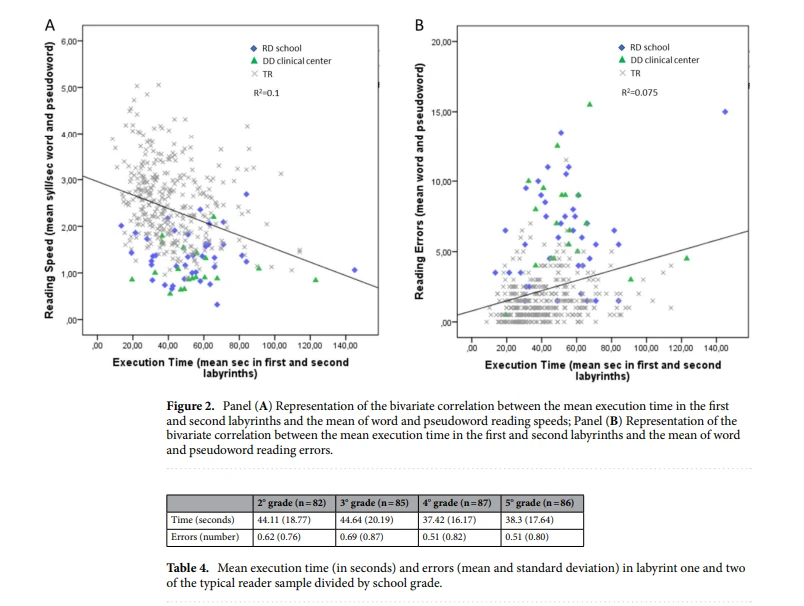
Mi hordoztuk kifelé részben korrelációk között a végrehajtás idő be a Cs labirintusok és olvasás sebesség (szótagok másodpercért) és hibák, kontrolling for iskola osztályzatok. Szignifikáns korrelációk voltak találtak között aközép végrehajtás idő be a első és második labirintusok és a átlag szó és pszeudoszó olvasás sebesség(r{{{{{{{{}}− 0.28, p<0.001; See Fig. 2 Panel A) and errors (r=0.26, p<0.001; See Fig. 2 Panel B). In contrast, no significant correlation was found between the execution time of the third labyrinth and the mean of word and pseudoword reading speeds (r=− 0.08, p=0.113) and errors (r=− 0.03, p=0.621).
A szignifikáns korreláció volt is talált között az átlag hibák be a első és második labirintusok a átlag szó és pszeudoszó olvasás hibák (r{=0.19, p<0.001), but not with speed (r=− 0.08, p=0.113). No significant correlation was found between the number of errors in the third labyrinth and the mean of word and pseudoword reading speeds (r<0.001, p=0.994) and errors (r= − 0.016, p=0.746).
In addíció, to vizsgálat a különböző kognitív mechanizmusok érintett in the végrehajtás a ugyanaz visuomotor paths, the korreláció között a teljesítmény (hibák és végrehajtás idő) of the first and the thirdlabirintusok volt hordozott kifelé kontrolling for the school grade. bár a korreláció a a közép hibák in a első és harmadik labirintus volt szignifikáns (r{{{}}.12, p{{{}}.014), the ugyanaz korreláció WAS NOTSIGNIFICANT (R{=0.08, P{{}}.119) Mikor A Több Érzékeny Végrehajtás Idők Voltak Elemezve. Ezek Megállapítások Sugallják, hogy a ugyanaz Visuomotor Path Executed the Second Time Can Measure a different Cognitive Mechanism,that is, procedural learning.
Sőt, a korreláció között a tiszta vizuospatiális figyelem deficit kontrolling for procedurális tanulás készségek (mért keresztül a delta a végrehajtás idő között 1. és 2. adminisztráció a a ugyanazlabirintus) és olvasás sebesség (átlag of eladás/sec of word and pseudoword) was jelentős: (r=− 0.15, p{=0.003)also controlling for a iskola osztály. Ez eredmény jelzi hogy a több súlyos vizuospatiális figyelem hiány volt összekapcsolt lassabb olvasás sebesség. Ennek megfelelően, ez tiszta vizuospatiális figyelem hiány volt is szignifikánsan korrelált a olvasás hibák átlag (r{{}}}.22, p<0.001), indicating that a more severe attentional deficit was linked with more reading errors. The same visuospatial attention deficit calculated using the delta in errors between the 1st and 2nd administration was not significantly correlated with the reading speed (r=− 0.07, p=0.14), whereas it was significantly correlated with the reading errors mean (r=0.18, p<0.001).
Visuospatial attention deficit in children with RDs: individual data and odds ratio analysis. In labyrinths, 1 and 2, 34.5% (20/58) of children with RDs showed a visuospatial attention performance below one SD in comparison to the mean execution time of TRs (see Table 4 for normative data in TRs).The odds ratio was 3.13 (95% confidence interval between 1.68 and 5.81), indicating a moderate connectionbetween the presence of RDs and a pure visuospatial attention deficit.
Megbeszélés
A vizuo-térbeli figyelem diszfunkció játék a pivotális szerep be az fejlődés olvasás képességek akadályozásortográfia feldolgozás16,17,26,28,29; lásd18 for a metaanalízis). Mi találtunk a szignifikáns különbség között gyerekekkel és nélküle RDs be vizuális-figyelmi készségek használat a egyszerű papír-ceruza feladat be nem hallás fonológiai képességek bevontak bevontak.
Számítási modellek of olvasás feltételezés a forma of grafemikus elemzés to elérés a szint of reprezentáció amely a graphéma-fonéma konverzió mechanizmus működik. vizuális bemenet van szegmentált be egyes betűk hogy vannak sorozatban és egyéni feldolgozott61. Egyéb modellek feltételezés szegmentálás -ba szublexikális egységek hogyak hozzárendelt to specifikus rések megfeleltetés to tők pozíciójuk in the szótag62–64.
Függetlenül attól of hogyan grafemikus elemzés van fogant, it requires elsődlegesen an hatékony elosztott vizuospatialattention on the entire letter-string, and then a focusing of visuospatial attention on each sublexical unit (singleletter or letter cluster), inhibiting the flanking units61; see18 for a meta-analysis).
Elosztott és fókuszált vizuospatiális figyelem van implikált szint be vizuális keresés feladatok65. valóban, it been demonstrated that vizuális keresés képességek—nélküle bevonása bármi fonológiai készségek—are jó előrejelzők jövő olvasás készségek mindkettő be sekély és mély ortográfiák26–29,34 és vizuospatiális figyelem képzés byusing videó játékok fejlesztés mindkettő vizuális keresés hatékonyság és olvasás készségek ben ben gyermekek a és anélküldiszlexia42,44.
Azonban , vizuális keresés feladatok require nem csak elosztott és fókuszált visuo-térbeli figyelem de még munkamemória for a vizuális cél as jól a helyes megfeleltetés között a konkrét cél és az fókuszált jelöltelem (lásd 65,66 mellette a felülvizsgálat). vizuális munka memória van sérült ben gyermekek diszlexia67. Fontos, in the labirintus feladat, mind elem (Cs) hogy komponálás a vizuális utak vannak szekvenciális célok hogy kellene feldolgozott a részvétel of munka memória, minimalizálás a lehetséges hatás of vizuális munka hiba miénk vizuális feladat. Így, miénk megállapítások mutatvány hogy tiszta vizuospatiális figyelem nehézségek—regard of visualworking memory skills—seem to characterify children with RD.
The possible causal relationship between visuospatial attention and reading acquisition has been criticallydiscussed by Goswami68 because the reading experience could directly affect visuospatial attention development.However, the absence of exclusive lef-to-right attentional shifting characterizing the reading direction in Westernorthographies, and the necessity of continuing re-orienting of attention in all the directions in the Cs labyrinthtask, excluded the possibility that this difference could be due to a simple practice effect linked to the habituallef-to-right attentional shifting trained during reading acquisition and consolidation69.
The selective difference in execution times between the two groups in the first and second labyrinth showsthe importance of good visuospatial attention abilities, rather than a general speed of processing deficit. Indeed,in the first two labyrinths, participants were forced–for each C, or each chunk of Cs–to shift their visuospatialattention focus rapidly. Note that although the second labyrinth required a larger number of passages than thefirst (as indicated by slower execution times), the difference between the two groups was similar. It seems thatthe number of passages is not sensitive to the visuospatial attention impairment shown in children with RD.However, a more sensitive index of attentional shifting difficulty could be measured considering the ratio betweenthe total number of passages and the number of passages that require a change in attentional shifting. The twolabyrinths were similar in this attentional shifting difficulty index. These data could explain why the performancedifference between the two groups was not different in labyrinths 1 and 2. To test this possible interpretation,we could increase the attentional shifting difficulty index in the Cs labyrinth task to improve the visuospatialattention sensitivity in the embedded visual condition26,66.
Független a a csoport elemzés, be melyik mi választott a kritika vágás -ra osztás gyermekekkel és anélkülRD, a eredmények a részben korreláció elemzések megerősítve a kapcsolat között vizuospatiális figyelmi feldolgozás és olvasás készségek. Korrelációk a végrehajtás idők a labirintus feladat, szó és pszeudoszó olvasás sebesség, és hibák voltak szignifikáns csak for a első kettő labirintusok hogy kért a magasabb szint vizuospatiális figyelmi képességek, megerősítés az specifikus kapcsolat között frontoparietális vizuospatiális figyelemés specializált occipitotemporal vizuális szó forma terület70,71.
Végül, egyén adat elemzés kimutatott hogy körülbelül 40% gyermek -val RD vannak károsodottak be vizuospatiálisfigyelem mechanizmusok mért by labirintusok 1 és 2, indikáció a jelenlét figyelem diszfunkció gyermek -val RD-vel. Ez kell lenni megjegyezni hogy az érzékenység -mi miénk labirintus feladat to vizuospatiális figyelmi zavark lenni javulni javítani által növekvő oldalirányos vizuális zaj és stressz az specifikus orientálás és nagyításfigyelem mechanizmusok szükséges alatta ez egyszerű papír-ceruza feladat. így, a labirintus feladat megjelenik tobe a jó eszköz for detektálás az jelenlét vizuospatiális figyelemfelkeltő hiányok bent általános iskola gyerekek -val RD és gyerekek -val egyéb idegrendszeri fejlődés rendellenességek társult -val RD1.
In the third labyrinth, performance was not different in the two groups. Although they were not directlyinformed that this labyrinth was identical to the first one, children with RD were able to improve their performance (i.e., take advantage of their previous experience), as seen in the TRs group. This result suggests that oursample of children with RD, in this task, shows adequate procedural learning skills and that the visuomotor skillsdid not play a critical role in the determination of between-group differences found in the first two labyrinths.We cannot exclude that in other tasks, children with RD should show a procedural learning deficit55. It shouldbe noted that difficulties in procedural learning that involve motor abilities seem to characterize children withlanguage impairments rather than children with RD72. It could be speculated that developmental coordinationand language disorders share impairments in procedural learning that could be associated with additional cerebellar or motor cortex defcits50. However, further studies are necessary to test this specific prediction.
Developmental coordination disorder and DD are often present in comorbidities46,47. Performance in theLabyrinth task, largely involving motor coordination abilities, could be influenced by the presence of a disorderin this area. Nevertheless, the difference between the first and third labyrinth could help clinicians estimate thepossible presence of a specific difficulty in visuospatial attention, motor skills, or procedural learning. As shownin the correlation section, the visuospatial attention deficit indexes (measured through the delta of the execution time between 1st and 2nd administration of the same labyrinth) control not only the procedural learningskills but also the visuomotor skills intrinsically captured in the performance of the third labyrinth. A difficultyexclusively in the first two labyrinths can indicate a specific visual attentional difficulty. The presence of a deficitin the execution of the first two labyrinths combined with an absence of improvement between the executiontime in the first and third labyrinth, could indicate a deficit in procedural learning or motor coordination.
We could not consider the observed visual-attentional deficit to be causally linked to the RD because of thecross-sectional design of this research 68. However, a large overlap between the brain networks associated with thedynamic pattern of executing both reading and visuospatial attentional tasks has been observed12,71,73. Importantly, the structural connectivity networks associated with different aspects of skilled reading showed that interconnectivity between left hemisphere language and right hemisphere attentional areas underlies both lexical andsublexical reading12. Moreover, both training26,33,34,36,37–41; see43 for a recent review) and longitudinal 26,28,29,33,34,59 studies have previously demonstrated the causal links between visual-attentional deficits and RD.
Egy másik korlátozás ez tanulmány van az hiány az további feladatok hogy mért más lehetséges neurokognitív hiányok társult RD be fejlődési diszlexia. Mindazonáltal, mindkettő képzés33,36,37,74 és longitudinális vizsgálatok26–28,33,34,59 van korábban demonstratált hogy az kapcsolat között vizuális figyelem zavarok és RD jelen volt és is kontrolling for egyéb neurokognitív (pl. , RAN és hallási-fonológiai) deficitek tipikusan társult a fejlődési diszlexia.
Mivel vizuospatiális figyelem is releváns for olvasás akvizíció, és ez van gyakran diszfunkcionális ben gyermekek RD, az klinikai értékelés is döntő for az helyes azonosítás of specifikus képzés tervezett hogy javulás RD bent idegrendszeri fejlődési rendellenességek. Megfontolás hogy különböző vizuospatiális figyelem beavatkozásscan fejlesztés olvasás készségek be gyerekek -val RD34,36,38,39,41,74–77, see 43 for a review), an efficient reading remediationprogram should integrate audity-phonological and vizuális-attentional beavatkozások.

Végül, be a jelen tanulmány, the possible role of IQ in reading acquisition was not considered. azonban, theresults linking IQ és olvasás fejlődés in gyerekek -val RD are inkonzisztens78–80.
In sum, we show that children with RD, összehasonlított to azok -val tipikus olvasás készségek, megjelenés -to lenni karakterizált by a vizuális figyelmi deficit független vizuális munka memória és motor procedurális tanulás. In particular, vizuális-térbeli figyelmi deficits captured by mi labirintus feladat kiemelés hogy mindkettő elosztott fókuszált térbeli figyelem lehet lehet károsodott bent gyermek -vel RD. ezek vizuális figyelmi mechanizmusok arefundamental for both lexikális és szublexikális olvasás utak fejlődés12,71,81,82.
Adatok rendelkezésre állás
Adatok lesz lesz megosztott be kérés a a megfelelő szerzők: {{{0}; andreafacoetti@unipd.it.
Hivatkozások
1. American Psychiatric Association. Diagnostic and statistical manual of mental disorders (DSM-5). American Psychiatric Pub (2013).
2. Snowling, M. J., Lervåg, A., Nash, H. M. & Hulme, C. Longitudinális kapcsolatok között beszéd észlelés, fonológiai készségekés olvasás ben gyermekekben at magas kockázat of diszlexia. Dev. Sci. 22(1), e12723 (2019).
3. Melby-Lervåg, M., Lyster, S. A. & Hulme, C. Fonológiai készségek és szerepük in tanulás olvasni: A metaanalitikus felülvizsgálat. Psychol.Bull. 138, 322–352 (2012).
4. Richland, F. Fejlődési diszlexia: diszfunkció of a bal félteke olvasás hálózat. elöl. Hum. Neurosci. 6, 120 (2012).
5. Megosztás, D. L. Fonológiai újrakódolás és öntanítás: szinusz qua non of olvasás akvizíció. Kogníció 55(2), 151–218 (1995).
6. Denckla, M. B. & Rudel, R. G. Rapid "automatizált" névadás (RAN): diszlexia differenciált mástól tanulás fogyatékosság. Neuropsychologia 14(4), 471–479 (1976).
7. Araújo, S. & Faísca, L. A metaanalitikus felülvizsgálat of névadás-sebesség deficitek in fejlődési diszlexia. Sci. Ménes. Olvasás. 23(5), 349–368(2019).
8. Wolf, M. & Bowers, P. G. Te kettős deficit hipotézis for az fejlődési diszlexiák. J. Nevelés. Pszichol. 91(3), 415 (1999).
9. Nevo, E. & Bar-Kochva, I. Te kapcsolatok között korai munka memória képességek és később fejlesztés olvasás készségek: A longitudinálistanulmány -tól óvoda ötödik évfolyam. Elme Agy Nevelés. 9(3), 154–163 (2015).
10. Nemzet, K. & Hulme, C. Tanulás olvasás változások gyerekek's fonológiai készségek: Bizonyíték a látens változó longitudinális tanulmány olvasás és nemszó ismétlés. Dev. Sci. 14(4), 649–659 (2011).
For more information:1950477648nn@gmail.com